

How much should I budget for Facebook ads and what factors influence the cost of Facebook Ads?
The cost of Facebook ads varies depending on the bid, ad quality, target audience, time period, and placement.
The average CPM calculated for 1000 impressions is around €5 to €10 in Belgium.
It is recommended to start with a modest daily budget (minimum €5 per day) to test and optimize campaigns.
Introduction
Facebook Ads are a powerful tool to reach your target audience and promote your business.
However, determining the appropriate budget for your Facebook Ads can be a challenge.
In this article, we'll walk you through the different considerations that go into creating an effective budget.
What factors influence the price and your budget on Facebook advertising?
A bidding system based on multiple factors
Many factors affect the cost of advertising on Facebook.
They understand:
Auction:
The price you pay for an ad space auction on Facebook. It can be set manually or automatically.
So, as the bid increases, the likelihood of your ad being shown to your target audience also increases.
Quality and relevance of your ad
An estimate of a person's interest in your ad.
Facebook calculates this based on your scores EQC
- Engagement
- quality
- Conversion
Timing
Facebook ads may be more expensive at certain times of the month, day, or even hour.
Target audience
The demographics that affect your Facebook advertising costs are:
- Location,
- Genre,
- Languages,
- Interest:,
- Behavior,
- Connections
The more marketers there are targeting the same audience, the higher the costs.
Time of year
Competition among marketers is high during:
- End of the year
- Summer
- Festival
- Days internationally
- black fridays
- Cyber Mondays
This results in an increase in the cost of your Facebook advertising.
Ad placement
You can place your ads in several advertising spaces, namely
- Facebook Desktop News Feed
- Facebook's Mobile News Feed
- Audience Network
- Etc.
The more people choose an investment, the more competitive and therefore more expensive it will be.
CPM
Facebook will take all of these elements into account to calculate your CPM (cost per mille / cost per 1000 impressions).
In French, the price Facebook charges you to get 1000 impressions.
Please note, if a user sees your ad 3 times, this counts as 3 impressions.
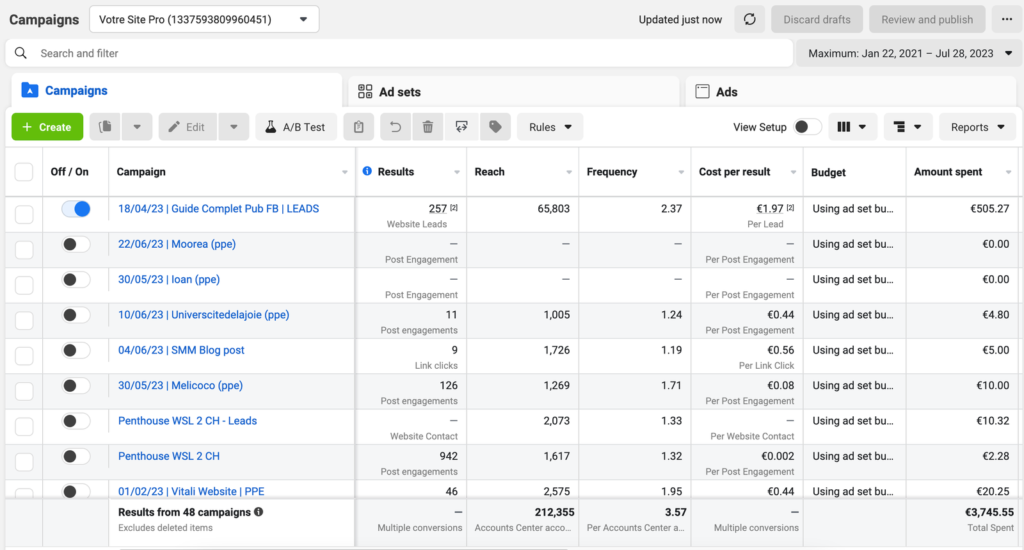
This cost will be displayed in your campaign reporting (see image below).

1. Define your advertising goals
Before determining your budget, it is essential to clarify your advertising goals. What do you want to accomplish with your ads? Facebook ?
Do you want to increase brand awareness, generate direct sales or increase conversions on your website?
Each goal will require a different budget.
2. Identify your target audience
Understanding your target audience is crucial to setting an effective budget. The more specific you are in your targeting, the more relevant and effective your ads will be. Use Facebook’s targeting tools to refine your audience based on criteria like age, gender, location, and interests.
This will help you avoid wasting money on people who aren't interested in your offer.

3. Evaluate the average costs of Facebook Ads
It is important to have an idea of the average costs of Facebook Ads for your industry. Costs vary based on competition and the quality of your ads. Facebook offers a tool called “Ad Benchmarks” that lets you see how ads are performing on average in your industry. This can give you an estimate of how much you’ll need to budget to achieve your goals.
4. Set a daily budget
To start, it’s a good idea to set a daily budget instead of a total budget. This will allow you to adjust your spending based on how your ads perform. Start with a smaller budget and gradually increase it once you’ve identified which campaigns are performing best.

5. Monitor and optimize your Facebook Ads campaigns
Once you’ve launched your Facebook Ads, it’s crucial to monitor them regularly and make adjustments if necessary. Analyze how your ads are performing in terms of clicks, conversions, and return on investment (ROI).
If a campaign isn't performing as expected, make changes to your targeting, ad creative, or offer to improve results.
6. Budget versus number of people affected
An important aspect to consider when determining your budget for Facebook Ads is the number of people you want to reach. The more people you want to reach, the larger your budget will need to be. If your goal is a broad reach, you will need to allocate additional resources to reach a larger audience. However, keep in mind that the quality of your audience is just as crucial as the quantity. Make sure to maintain a balance between budget and the effectiveness of your ads.
7. The company's marketing budget and return on investment
When determining your budget for Facebook Ads, it’s important to consider your overall marketing budget. You don’t want to allocate your entire marketing budget to Facebook Ads, but rather evaluate how much you can wisely invest in that specific advertising platform. You should also consider the potential ROI. Analyze the results of your previous campaigns to assess how much you spent and how much you earned in return. This will help you determine what percentage of your overall marketing budget can be allocated to Facebook Ads while still maximizing ROI.

8. Test different strategies
It’s recommended that you test different advertising strategies to find what works best for your business. Try different ad types, targeting, and budgets to see what gives you the best results.
Facebook also offers A/B testing features that allow you to compare different variations of your ads to see which one works best.

9. The importance of testing different (visual) creations
The importance of testing different visual creatives in Facebook Ads campaigns remains the most important element of your campaign.
By performing A/B testing on different visuals, you can find out which images, graphics, or videos attract the most attention from your target audience.
This will lead to increased clicks and conversions.
This practice allows strategies to be adjusted in real time, based on hard data rather than guesswork. Regular testing can also reveal seasonal trends or changes in audience preferences, allowing campaigns to be adapted quickly and effectively.
Ultimately, testing visuals contributes to more efficient use of advertising budget and an overall improvement in ROI.

10. Frequently Asked Questions
- Budget adjustment: Regularly analyze performance data, such as cost per acquisition (CPA) and conversion rate. If an ad is performing well, duplicate it and increase the budget in the duplicated campaign. For underperforming ads, stop them.
- Daily budget vs. total: Daily budget controls daily spending, allowing for agile adjustments. Total budget is useful for campaigns with a clear start and end, allowing for precise financial planning.
- Algorithm changes: When Facebook updates its algorithm, monitor the impact on your campaigns. Adjust target audiences, ad content, and bids based on new best practices.
- common mistakes: Give Meta time to test your ad with enough coverage. If you don't give the algorithm enough time to find the right target, your campaigns will never get out of the learning phase.
- Measuring ROI: Use Meta Pixel and Conversion API to track specific user actions. Compare campaign costs to revenue generated to assess success and adjust strategies accordingly. You can also use UTM parameters to have even more effective tracking.
11. Conclusion
Determining the right budget for Facebook Ads requires a thoughtful approach based on your goals and target audience. Evaluate average costs, set a daily budget, and carefully monitor the performance of your campaigns. By testing different strategies, you can optimize your Facebook ads for the best results. With careful planning, Facebook Ads can be a worthwhile investment for your business.
Also discover the new Meta Subscription and stay informed about the latest news.
You would like to talk about it to a facebook ads expert ?